The dollar came untethered
In August 1971 the United States ended the dollar's convertibility to gold. Since then the currency has floated freely, backed by nothing but confidence — and the willingness of policymakers to restrain the printing press.
Established for the sound-money citizen
No. I · A Patriot Money Broadside · Vol. MMXXVI
The dollar in your retirement account is a promise made by people who can print more of it. Gold is not. For generations, free citizens have anchored their wealth in honest, sound money that no central bank can dilute by decree — and today the case is as plain as ever.
Patriot Money is an independent resource that lays out the facts, explains why gold has served as sound money for millennia, and helps you move retirement savings into physical metals through companies worth your trust.

The Plain Facts
We deal in facts, not fear. The figures below are approximate and drawn from public records; they are offered for education, not as a prediction or a promise.
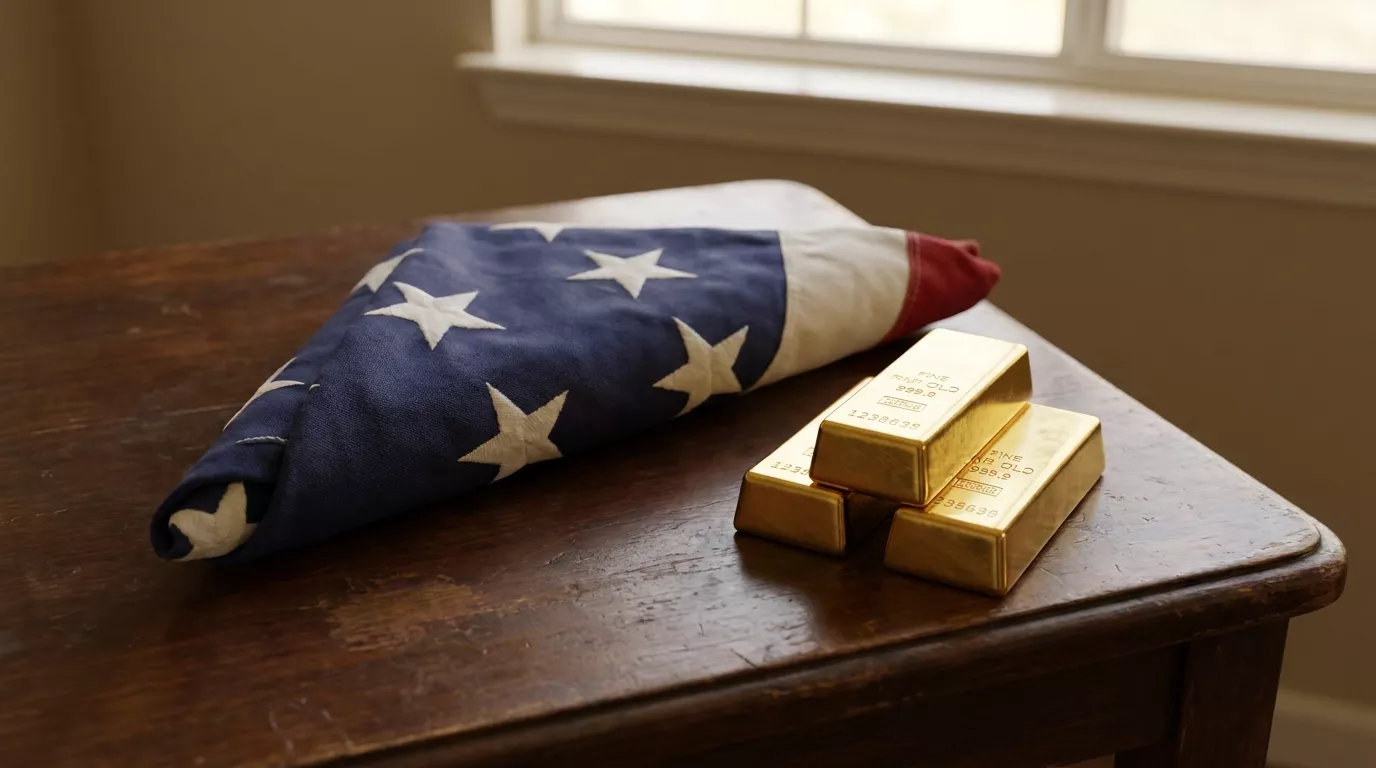
What you can hold cannot be printed away.
In August 1971 the United States ended the dollar's convertibility to gold. Since then the currency has floated freely, backed by nothing but confidence — and the willingness of policymakers to restrain the printing press.
By common inflation measures, a 1971 dollar buys roughly an eighth of what it once did — an approximate loss of around 86% of its purchasing power. What cost a dollar then costs several today.
The U.S. national debt has grown past $36 trillion (approximate, and rising). History is clear that nations carrying heavy debt face strong temptation to inflate it away — at the saver's expense.
Recent years brought the sharpest consumer-price increases in four decades. Even after cooling, prices rarely fall back — they simply rise more slowly from a permanently higher base.
Figures are approximate and for general education only. Sources include the U.S. Bureau of Labor Statistics, the U.S. Treasury, and historical gold price records. Past performance does not guarantee future results.
First Principles
“Sound money” is currency that holds its value because its supply cannot be expanded at will. For most of American history, that meant gold and silver. The principle did not change in 1971 — only the policy did.

No government can conjure gold into existence. Its supply grows only a small amount each year through hard, costly mining — which is precisely why it has resisted the debasement that erodes paper currencies.
Across five thousand years and countless failed currencies, gold has remained money. Empires fell; their coins endured. That continuity is the foundation of the sound-money tradition.
Physical gold is not a counterparty's promise or an entry in someone else's ledger. Held properly, it is wealth you control directly — a quality the founders of sound-money thinking prized above all.
A gold IRA is an IRS-recognized, self-directed account that lets you hold approved physical metals with the same tax advantages as a conventional IRA — sound money inside a retirement wrapper.
The Patriot Money Almanac
Our independent assessment for the year of our Lord MMXXVI — the dealers worth your retirement, weighed on fees, transparency, storage, reputation, and buyback terms.
Our top-rated featured partner: BBB A+ rated, transparent spot-based pricing, IRS-approved depository partners, and a no-obligation buyback commitment. Full details on newmontcapitalgroup.com.
Well-known brand with a strong educational focus; notably high account minimum.
4.7 / 5 · min $50,000
min $50,000
High-volume dealer with a low entry point and frequent promotions.
4.6 / 5 · min $10,000
min $10,000
Long-running dealer with a wide range of IRS-approved metals.
4.2 / 5 · min $10,000
min $10,000
Large, established gold IRA provider with broad brand recognition.
4.1 / 5 · min $25,000
min $25,000
Ratings are our independent editorial opinion, not user reviews. See all company reviews →
From the Almanac
Short, honest explainers for citizens doing their own homework — no jargon, no scare tactics.
The step-by-step on a direct, penalty-free rollover, the 60-day trap to avoid, and what a good custodian handles for you.
ProtectionThe red flags of high-pressure 'free silver' offers, numismatic upsells, and dealers who won't put fees in writing.
EligibilityPurity standards, approved mints, and why collectible 'numismatic' coins usually don't belong in a retirement account.
Straight Answers
Because gold's supply can't be expanded at will like paper currency, it has historically tended to hold or grow its real value during periods of high inflation and currency debasement. Since the dollar left the gold standard in 1971, it has lost roughly 86% of its purchasing power while gold has risen from $35/oz into multi-thousand-dollar territory. These figures are approximate, and past performance does not guarantee future results.
A gold IRA is a self-directed, IRS-recognized retirement account that holds physical precious metals instead of (or alongside) stocks and bonds. The account type is entirely legitimate. Risk comes from bad actors, not the product — which is why we stress working with established, transparent, BBB-rated companies that use IRS-approved depositories.
Yes, when it's done correctly. A direct rollover (trustee-to-trustee transfer) of eligible 401(k) or IRA funds into a self-directed gold IRA is not a taxable event. Problems usually arise with indirect rollovers that miss the 60-day window. A reputable custodian and dealer will handle the paperwork to keep it penalty-free.
No. Sound money is an American idea older than today's political labels — it runs from the founders through generations of savers across the spectrum. Patriot Money speaks to citizens who simply want to protect what they've earned from inflation. The principles here are economic, not partisan.
The IRS permits certain gold, silver, platinum, and palladium products that meet minimum purity standards (for example, 99.5% for gold) and come from approved mints and refiners — such as American Gold Eagles and many bullion bars. Collectible or graded 'numismatic' coins are generally not eligible.
Free · No obligation
A plain-English guide to protecting retirement savings with physical metals — plus a no-pressure consultation with our top-rated partner. Your information stays private.